新書推薦:

《
2045:AI改变人类未来的十大趋势(揭示未来二十年超级震撼的科技变革全景图)
》
售價:NT$
347

《
新知文库精选·骆驼来自何处:外来入侵物种的故事与科学
》
售價:NT$
352

《
沟通:终身原则(第八版)
》
售價:NT$
1010

《
小狗心理疗愈日记 史努比陪你找到自我主体性 走出艰难时刻
》
售價:NT$
214

《
心灵银行 脑科学轻松创造真正的改变 世界级催眠大师约翰卡帕斯送给普通人改写命运的秘密武器
》
售價:NT$
347

《
被偷走的尊严:美国保守派的失落、耻辱与奋起(三联·哈佛燕京学术丛书)
》
售價:NT$
398

《
尖叫的数学:令人惊叹的数学之美:修订新版(从数学的角度发现不一样的逻辑和处世哲学。随书附赠手账本。)
》
售價:NT$
296

《
数学老师没教过的数学
》
售價:NT$
214
|
| 內容簡介: |
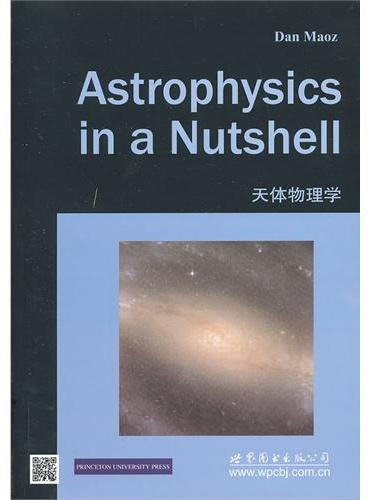
《天体物理学》由Dan Maoza(马泽)著,主要内容:This textbook is based
on the one-semester course "Introduction to Astrophysics," taken by
third-year physics students at Tel-Aviv University, which I taught
several times in the years 2000-2005. My objective in writing this
book is to provide an introductory astronomy text that is suited
for university students majoring in physical science fields
physics, astronomy, chemistry, engineering, etc., rather than for
a wider audience, for which many astronomy textbooks already exist.
I have tried to cover a large and representative fraction of the
main elements of modem astrophysics, including some topics at the
forefront of current research. At the same time, I have made an
effort to keep this book concise.
|
| 目錄:
|
Preface
Constants and Units
1 Introduction
1.1 Observational Techniques
Problems
2 Stars: Basic Observations
2.1 Review of Blackbody Radiation
2.2 Measurement of Stellar Parameters
2.3 The Hertzsprung-Russell Diagram
Problems
3 Stellar Physics
3.1 Hydrostatic Equilibrium and the Virial Theorem
3.2 Mass Continuity
3.3 Radiative Energy Transport
3.4 Energy Conservation
3.5 The Equations of Stellar Structure
3.6 The Equation of State
3.7 Opacity
3.8 Scaling Relations on the Main Sequence
3.9 Nuclear Energy Production
3.10 Nuclear Reaction Rates
3.11 Solution of the Equations of Stellar Structure
3.12 Convection
Problems
4 Stellar Evolution and Stellar Remnants
4.1 SteUar Evolution
4.2 White Dwarfs
4.3 Supernovae and Neutron Stars
4.4 Pulsars and Supernova Remnants
4.5 Black Holes
4.6 Interacting Binaries
Problems
Star Formation, H. Regions, and the Interstellar Medium
5.1 Cloud Collapse and Star Formation
5.2 H II Regions
S.3 Components of the Interstellar Medium
5.4 Dynamics of Star-forming Regions
Problems
6 The Milky Way and Other Galaxies
6.1 Structure of the Milky Way
6.2 Galaxy Demographics
6.3 Active Galactic Nuclei and Quasars
6.4 Groups and Clusters of Galaxies
Problems
7 Cosmology: Basic Observations
7.1 The Olbers Paradox
7.2 Extragalactic Distances
7.3 Hubble''s Law
7.4 Age of the Universe from Cosmic Clocks
7.5 Isotropy of the Universe
Problems
Big Bang Cosmology
8.1 The Friedmann-Robertson-Walker Metric
8.2 The Friedmann Equations
8.3 History and Future of the Universe
8.4 A Newtonian Derivation of the Friedmann Equations
8.5 Dark Energy and the Accelerating Universe
Problems
Tests and Probes of Big Bang Cosmology
9.1 Cosmological Redshift and Hubble''s Law
9.2 The Cosmic Microwave Background
9.3 Anisotropy of the Microwave Background
9.4 Nucleosynthesis of the Light Elements
9.5 Quasars and Other Distant Sources as Cosmological
Probes
Problems
Appendix. Recommended Reading and Websites
Index
|
|

 購物車/收銀台(0) | 在線留言板
| 付款方式
| 聯絡我們
| 運費計算
| 幫助中心 |
加入書簽
購物車/收銀台(0) | 在線留言板
| 付款方式
| 聯絡我們
| 運費計算
| 幫助中心 |
加入書簽 HOME
HOME 新書上架
新書上架