新書推薦:

《
上她的船 新人作家蹦蹦号 一部致敬时间、致敬女人的作品
》
售價:NT$
356

《
古河道对地下工事风险影响研究——广州等城市地下工事风险案例溯源
》
售價:NT$
1525

《
1978:留学改变人生:中国改革开放首批赴美留学生纪实
》
售價:NT$
305

《
魏晋南北朝史研究(第3辑)
》
售價:NT$
1010

《
中国丝绸艺术大系·北京艺术博物馆卷
》
售價:NT$
4998

《
黑暗中我们能走多高 永松红杉科幻文学
》
售價:NT$
347

《
肌肉能量技术:物理治疗师实践指南(第2版)
》
售價:NT$
653

《
椭圆曲线故事集
》
售價:NT$
398
|
| 編輯推薦: |
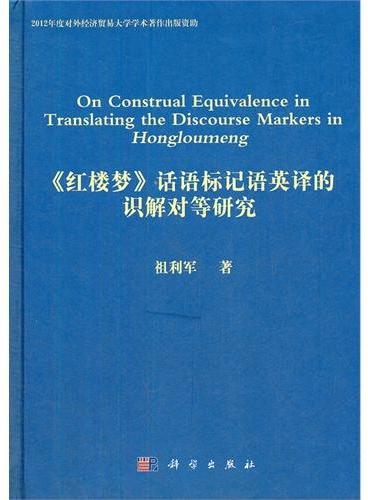
在《红楼梦话语标记语英译的识解对等研究》一书中,作者祖利军以《红楼梦》前八十回的霍译本和杨译本为语料,对其中话语标记语的英译做详细研究,目的在于发现其中的翻译策略及这些策略背后的认知因素。
本书首次提出“识解对等”,把翻译策略研究引向更深入的认知层面,从而为翻译研究提供了一个全新的认识途径。
|
| 內容簡介: |
|
本研究在相关讨论的基础上,将《红楼梦》中话语标记语从语用功能方面划分为六类:引发评论、诱导推理、引证信息、引发话题、揭示事实和因果识别。为了解释这些功能的英译策略,本研究在批评借鉴传统翻译对等理论和兰艾克的识解理论的基础上,提出了“识解对等”这一假设。与传统翻译对等理论相比,该假设更突出认知在翻译中的作用,因而对翻译更具解释力。识解是人脑对同一概念内容所做的不同描述或表达。同样,译者也可以就同一概念内容做出不同的翻译。译文的差异可以通过视角、详略度、突显和背景等识解因素表达出来。研究发现,《红楼梦》话语标记语的翻译策略主要有变通、具体化、移位、直译、融合、结构平行、异化和归化。
|
| 目錄:
|
前言
Acknowledgements
Chapter 1 Introduction
Chapter 2 Defining and Classifying DMs
2.1 DMs in English and Chinese
2.2 Functional diversity of DMs
2.3 Classification of DMs
2.4 Instantiating the pragmatic functions of DMs in Hongloumeng
2.4.1 Opinion-indicating
2.4.2 Deduction-eliciting
2.4.3 Evidence-quoting
2.4.4 Topic-initiating
2.4.5 Fact-revealing
2.4.6 Cause-and-effect identifying
2.5 Summary
Chapter 3 Toward a Working Translation Critierion:Construal Equivalence
3.1 Traditional translation criteria
3.1.1 Traditional Chinese translation criteria:fidelity based on aesthetics
3.1.2 Traditional western translation criteria:equivalence based on linguistics
3.2 Toward a working translation criterion:construal equivalence
3.2.1 Relationship between cognitive semantics and translation
3.2.2 Definition of construal
3.2.3 A working translation criterion:construal equivalence
3.3 Factors affecting construal equivalence
3.3.1 Linguistic factors
3.3.2 The translator''s manipulation
3.4 Significance of translation equivalence
3.5 Summary
Chapter 4 Strategies in Relation to Perspective-based Equivalence
4.1 Shifts in narrative points of view
4.2 Synesthetic shifts
4.3 Shifts between human senses and mental processes
4.4 Shifts between human senses and other processes
4.5 Shifts between mental processes
4.6 Shifts from generality to concreteness
4.7 Syntactic shifts
4.8 Summary
Chapter 5 Strategies in Relation to Prominence-based Equivalence
5.1 Transposition
5.2 Literal translation
5.3 Transmigration
5.4 Structural parallelism
5.5 Summary
Chapter 6 Strategies in Relation to Background-based and Specificity-based Equivalence
6.1 Domestication
6.2 Foreignization
6.3 Holism
6.4 Summary
Chapter 7 Implications and Future Perspectives
References
Appendixes
Appendix A Translation of Opinion-indicators
Appendix B Translation of Deduction-elicitors
Appendix C Translation of Evidence Quoters
Appendix D Translation of Topicalizers
Appendix E Translation of Fact-revealers
Appendix F Translation of Cause-and-effect Identifiers
|
| 內容試閱:
|
Introduction
Hongloumeng1 is one of the canonical works in the history of Chinese literature. Zhou Ruchang once made this comment:
If you intend to know about the cultural characteristics of the Chinese nation, the best way, interesting and expedient, is to peruse Hongloumeng. It is a ‘cultural novel’ which is unprecedented and unique to the Chinese nation in the long history of China. It is a work that is the most representative of Chinese national culture.2
2009:4-9 the author’s translation
Indeed, since the first publication of Hongloumeng in the Qing dynasty, numerous readers have been enchanted and infatuated by the charm and glamour of Cao Xueqin’s language. Scholars have paid special attention to it and tried to conduct research from various per-
1 According to Jiang Fan’s 2007: 20-23 research on the title translation of the novel, David Hawkes 1973-1980 translates it as The Story of the Stone while Yang Xianyi and Gladys Yang 1978-1980 render it as A Dream of
|
|

 購物車/收銀台(0) | 在線留言板
| 付款方式
| 聯絡我們
| 運費計算
| 幫助中心 |
加入書簽
購物車/收銀台(0) | 在線留言板
| 付款方式
| 聯絡我們
| 運費計算
| 幫助中心 |
加入書簽 HOME
HOME 新書上架
新書上架